
ADA Parking Lot Markings: Complete Compliance Guide 2026
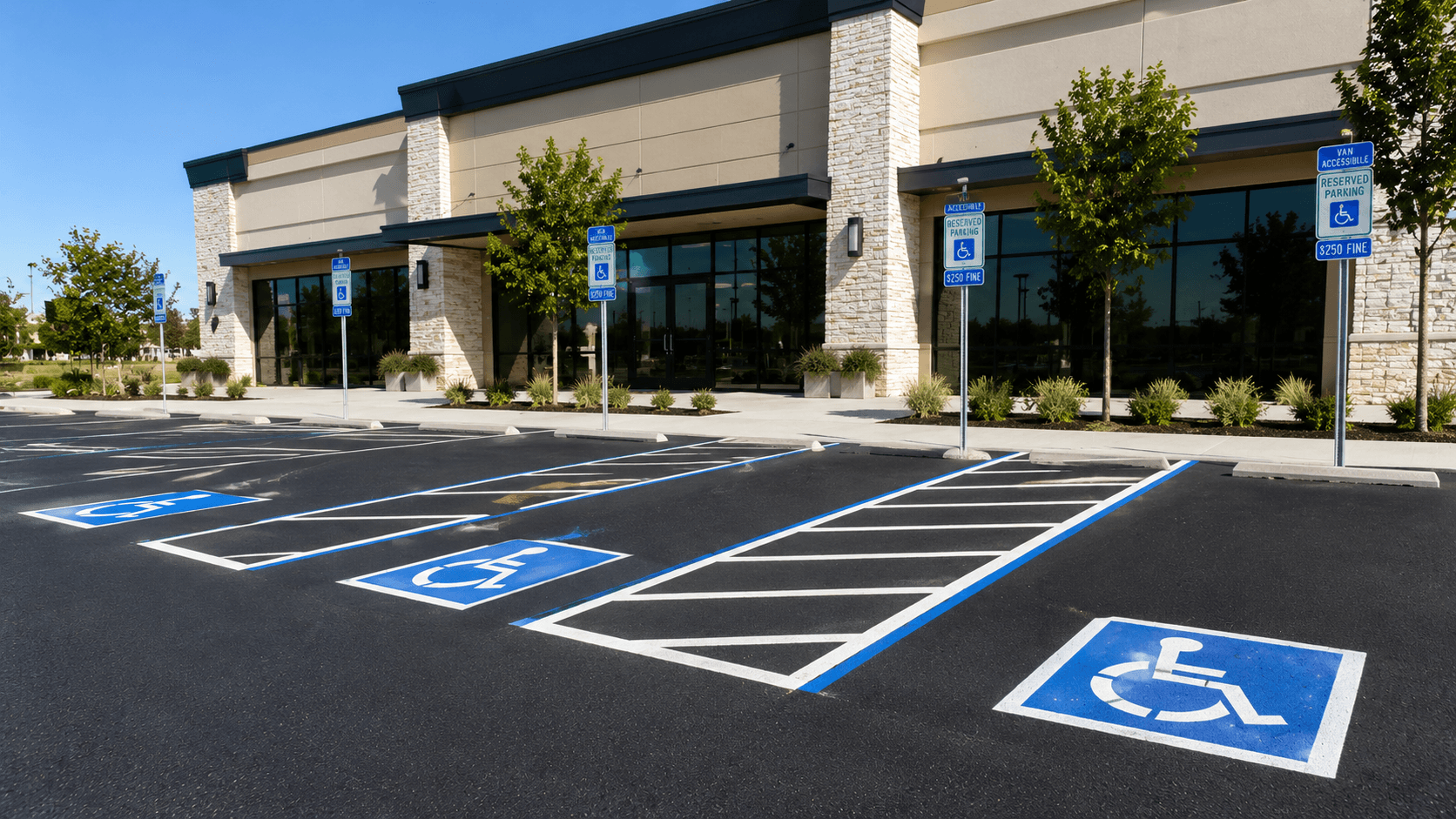
Of all the work we do, ADA markings are the one where the rules aren't optional and the mistakes get expensive. A faded symbol or an access aisle two inches too narrow can mean a complaint, a fine, or a lawsuit ,even if the rest of your lot is flawless.
The good news: the rules aren't complicated once someone lays them out plainly. I'm Gabriel, founder of FineLines. We stripe ADA-compliant lots across 45+ states, so here's the 2026 guide I wish every property owner had before their first inspection.
One note up front: the federal rules come from the 2010 ADA Standards for Accessible Design, and those are still the governing standard in 2026. This is general guidance, not legal advice, and your state or city may be stricter — more on that below.
Why These Markings Matter More Than a Fine
It's easy to treat accessible parking as "a blue box and a sign." It's really a system that has to work for a real person , someone in a wheelchair, on a walker, or in a lift-equipped van , getting from their car to your door without hopping a curb or squeezing past traffic.
That's why enforcement is serious. Non-compliance can bring a federal complaint, civil penalties, and private lawsuits, on top of the cost of redoing the work. Getting it right the first time is always cheaper.
How Many Accessible Spaces Do You Need?
The first rule most people get wrong: you count per lot, not per property. Each parking lot or garage gets its own calculation , even if you own ten of them.
Here's the federal minimum:
| Total spaces in lot | Minimum accessible |
|---|---|
| 1–25 | 1 |
| 26–50 | 2 |
| 51–75 | 3 |
| 76–100 | 4 |
| 101–150 | 5 |
| 151–200 | 6 |
| 201–300 | 7 |
| 301–400 | 8 |
| 401–500 | 9 |
| 501–1,000 | 2% of total |
| 1,001+ | 20 + 1 per 100 over 1,000 |
Then the van rule: at least one of every six accessible spaces must be van-accessible (round up). So a lot needing 4 accessible spaces needs 1 van space; a lot needing 8 needs 2.
(Medical and rehab facilities have higher ratios , ask us if that's your property type.)
The Dimensions Inspectors Actually Check
This is where compliance is won or lost. Every number below is a minimum.
Standard accessible space
- 96 inches (8 ft) wide, plus a 60-inch (5 ft) access aisle beside it
Van-accessible space
Two layouts are allowed:
- 132 inches wide + a 60-inch aisle, or
- 96 inches wide + a 96-inch aisle
- Plus 98 inches of vertical clearance for the space, aisle, and the route the van drives — important if you have a canopy or garage
Access aisles
- Must be the same length as the space they serve
- Must be marked with hatching so drivers don't park in them
- Two spaces can share one aisle ; except angled spaces, where the aisle goes on the passenger side
Slope and surface
- Maximum slope 1:48 (about 2%) in every direction, so a wheelchair doesn't roll
- Surface must be firm, stable, and slip-resistant -cracks, potholes, and worn striping can all fail you here
Signage Rules
Ground markings aren't enough , signs matter too:
- Each accessible space needs the International Symbol of Accessibility (ISA) sign
- Mounted at least 60 inches above the ground, measured to the bottom of the sign (so it's visible over a parked car)
- Van spaces need an added "Van Accessible" sign
- Exception: lots with four or fewer total spaces still need one van-accessible space, but no sign is required.
Don't Forget State and Local Codes
Federal ADA is the floor, not the ceiling. Plenty of states and cities go further, California is the well-known example, with stricter slope, signage, and surface rules. Some require specific paint colors or extra signage.
This is exactly why we confirm the requirements for your property's location and type before we stripe a single line. A layout that passes in one state can fail in another.
When Re-Striping Triggers Full Compliance
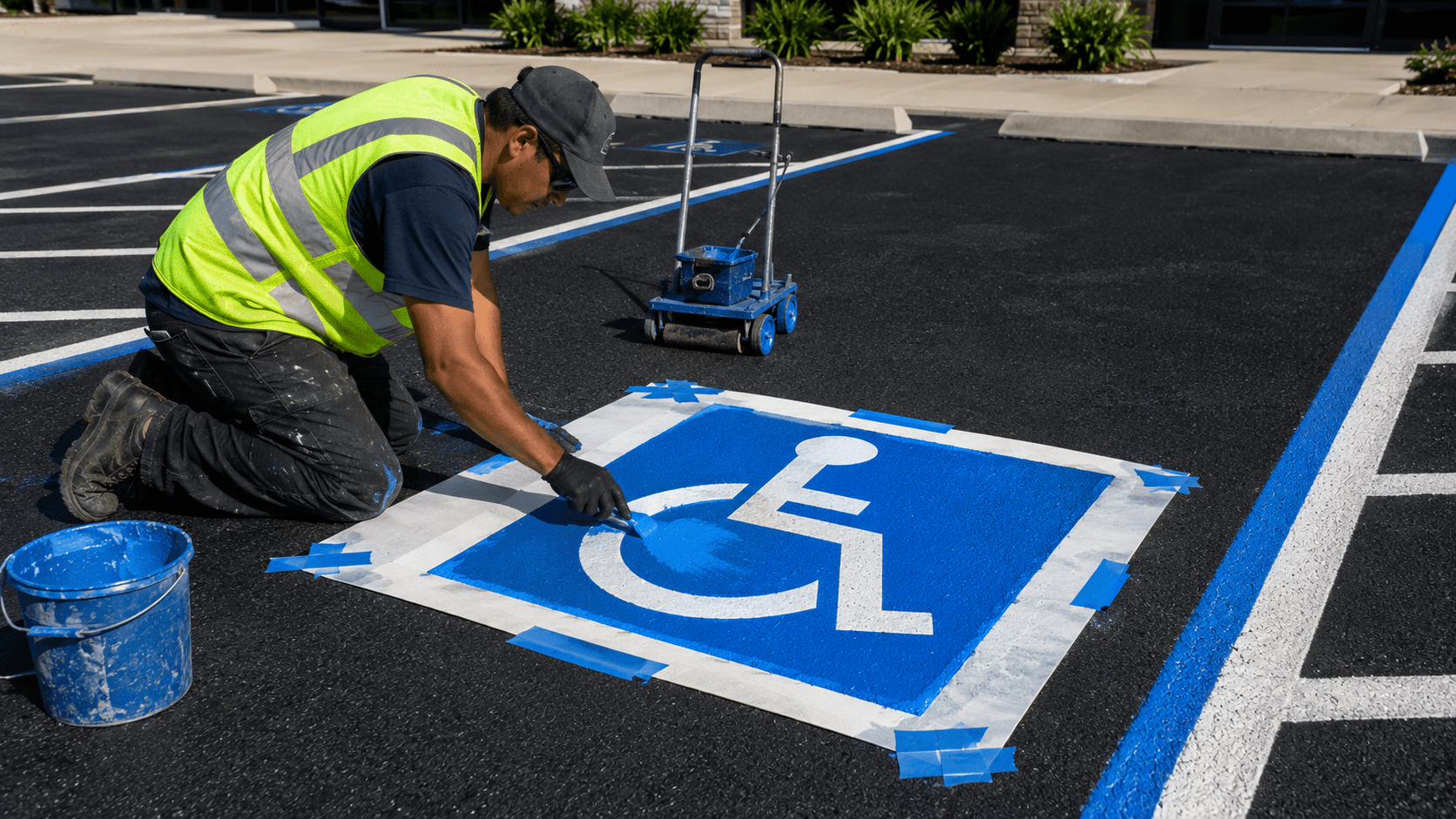
Here's the one that catches owners off guard. Any time you re-stripe or resurface, that lot has to meet current 2010 Standards , even if it was "grandfathered" before. Re-striping counts as an alteration.
So if your lot was laid out years ago and it's due for fresh paint, that's the moment to bring everything up to code: layout, aisle widths, signage, all of it. Handling it in one pass with ADA-compliant striping is far cheaper than getting flagged and redoing it later.
You can verify every requirement on the official ADA.gov accessible parking page , it's the federal source we work from.
Quick ADA Compliance Checklist
Before your next inspection, confirm:
- Correct number of accessible and van spaces for that lot
- Right widths for spaces and aisles
- Aisles hatched and the same length as the space
- Slope at or under 2% in all directions
- ISA signs at 60 inches, "Van Accessible" where needed
- Surface in good repair, symbols and lines clearly visible
FAQs
How many accessible parking spaces does my lot need?
It depends on that lot's total spaces. A lot of 1–25 needs one (van-accessible) space; 100 spaces needs four; 500 needs nine. Then one of every six accessible spaces must be van-accessible. Remember, you calculate this per lot, not across your whole property.
Do I need a "Van Accessible" sign on every accessible space?
No, only on the van-accessible ones. Every accessible space needs an ISA sign at 60 inches; van spaces get an extra "Van Accessible" sign. The exception is lots of four or fewer spaces, which need a van space but no sign.
Does re-striping my parking lot trigger ADA compliance?
Yes. Re-striping or resurfacing is considered an alteration, so the lot must meet current 2010 ADA Standards afterward, even if it predated them. It's the ideal time to correct old layout or signage issues in one job.
What are the penalties for non-compliant ADA parking?
Non-compliance can lead to federal civil penalties, private lawsuits, and the cost of redoing the work. Beyond the money, it keeps people with disabilities from accessing your property. Fixing it proactively is always the cheaper path.
Free Site Assessment